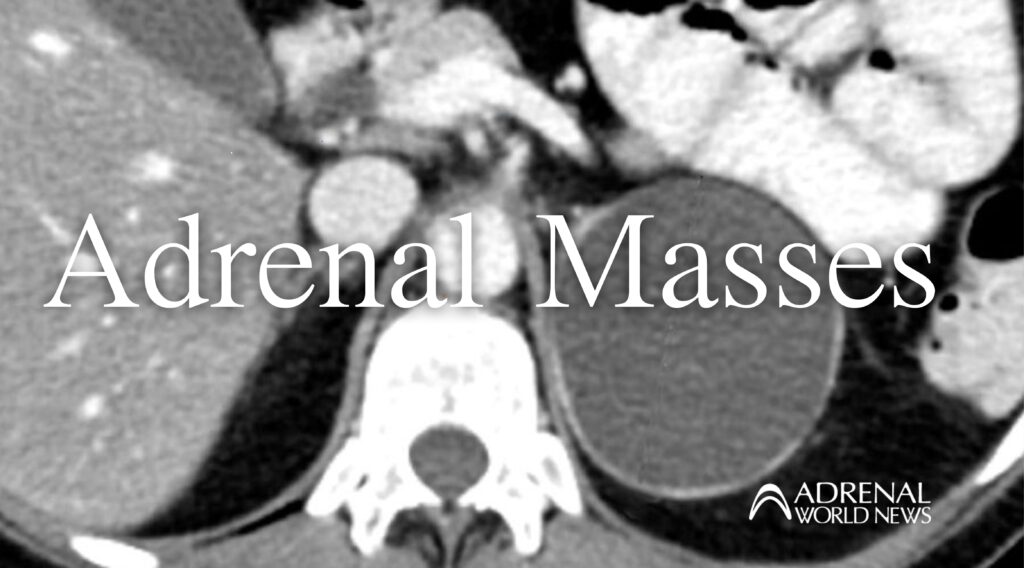
A commentary on adrenal masses by Dr. Lewis Blevins, AWN cofounder – My experience with adrenal disorders is that radiologists often miss things. Some adrenal nodules are not even reported on CT scans of the abdomen done for various unrelated reasons. Also, radiologists often miss adrenal hyperplasia. In my opinion, adrenal glands with limb thickness greater than 5 mm are abnormal. Radiologists often use a cutoff of 15 mm before they report the adrenal as enlarged. Using their criterion would misdiagnose most of my patients with pituitary Cushing’s, about 65% with ectopic ACTH secretion, and many more with primary adrenal hyperplasia and MACS. Further, a study has shown that, even when the radiologist mentions an adrenal mass, in most cases the affected patients never have a proper work-up. Endocrinologists tend to work up about 75% of patients. It should be 100%! If you see an adrenal lesion or mass on your CT scan report, insist on a referral to an endocrinologist and a thorough work-up for the conditions I’ll review below.
A wide variety of disorders can present as one or more masses in the adrenal glands. An entirely different set of conditions can cause adrenal enlargement. I’ll focus on some of the more common things, most of which I’ve seen, in this article.
Adrenal adenomas are usually benign solitary tumors derived from the adrenal cortex. Sometimes they occur as one in each adrenal gland, but most are one-sided. They may produce hormones such as aldosterone, cortisol, or 11-deoxycorticosterone. I’ve seen one androgen-producing tumor in 35 years. Older recommendations were to not do hormone analyses unless there were clinical symptoms and signs of Cushing’s or aldosterone excess. I’ve seen a lot of patients with hormone hypersecretion with minimal clinical features, so I recommend testing including: ACTH, cortisol, DHEA-S, an overnight 1 mg dexamethasone suppression test, plasma renin, aldosterone, and when indicated, other androgens and 11-deoxycorticosterone.
A few caveats include the following:
- Most benign adenomas do not progress in size
- Malignancy occurring in a benign adenoma is rare
- Cortisol-producing adenomas greater than 2 cm in diameter are often associated with cortisol excess
- Mild autonomous cortisol secretion is common
- Many patients with hyperaldosteronism have tumors that also secrete cortisol
- Lesions greater than 5 cm should be surgically removed
Adrenocortical cancer usually presents with pain and as a large tumor with evidence for necrosis. Patients may have one or more syndromes of hormone hypersecretion.
Myelolipoma is a complex benign tumor composed of fatty tissue, adrenocortical tissue, and bone marrow elements. They may be associated with bleeding. They usually have calcification. Sometimes they even appear as malignant lesions, and their true nature is only revealed by surgical removal.
Pheochromocytoma is a tumor of the adrenal medulla. They often present with symptoms of catecholamine excess. Testing includes assessment of plasma and urine catecholamines and their metabolites including epinephrine, norepinephrine, dopamine, metanephrines, normetanephrines, and VMA. While most pheochromocytomas are one-sided, some patients have tumors in both adrenal glands. This situation should suggest an underlying genetic condition such as MEN-2A, MEN-2B, neurofibromatosis-1, or von Hippel-Lindau syndrome.
I had a recent patient who had a rare ganglioneuroma of the adrenal gland.
Neuroblastoma may occur in childhood. These are often quite large.
Adrenal nodular hyperplasia, either silent or hormonally active, can cause both adrenal glands to become enlarged. Excessive ACTH secretion from a pituitary tumor or some other neuroendocrine tumor can cause adrenal enlargement. Congenital adrenal hyperplasia due to enzyme deficiencies is usually evident from birth or childhood, but there is a late-onset form.
Bilateral adrenal hemorrhage is often associated with acute adrenal insufficiency and has a characteristic appearance on imaging studies.
Metastatic lesions to the adrenal glands are often multiple and may cause nodules in both glands. Some patients have a single nodule. They may be destructive and cause adrenal insufficiency. Most patients have a known cancer such as small cell lung carcinoma, kidney cancer, melanoma, or colon cancer.
Fungal infections, such as histoplasmosis and cryptococcosis, can infiltrate both adrenal glands and cause enlargement associated with adrenal insufficiency.
Tuberculosis can cause adrenal enlargement with calcifications. Many patients have adrenal insufficiency. This is a common cause of adrenal insufficiency in parts of the world where tuberculosis is common.
 Listen to this fascinating discussion of adrenal Cushing’s or hypercortisolism as Dr. Lewis Blevins walks us through the disease’s characteristics, biochemistry, and treatment options. Now on the Adrenal World News Podcast – (logo here)
© 2026, AWN. All rights reserved.